Week 8
A Culture of Coaching with Compassion
High standards, human approach. Grow people and performance together.
Introduction
In today’s fast-paced work environment, the role of leadership goes far beyond managing tasks or driving results. At the heart of truly impactful leadership lies compassionate coaching, an approach rooted in empathy, understanding, and support. It is about creating an environment where team members feel valued, heard, and motivated to grow. Compassionate coaching is not about lowering expectations; it is about helping people rise to meet them. It is about seeing potential where others see problems and guiding people with both high standards and humanity.
When leaders coach with compassion, they build stronger teams, elevate performance, and create a workplace culture that people want to be part of. This post explores the core principles of compassionate coaching, its benefits, how to apply it in daily leadership, and how to balance empathy with accountability - the ultimate leadership dichotomy.
1) The Principles of Compassionate Coaching
- Empathy and active listening. Compassionate coaching begins with understanding. Listen, truly listen, without judgment. Pause long enough to hear what someone is saying and what they are not saying. Leaders who actively listen build trust and show they care about the person, not just the performance.
- Building trust and psychological safety. A coaching culture cannot exist without trust. Team members need to feel safe to speak up, share ideas, and admit mistakes without fear. Psychological safety builds confidence, and confidence fuels growth.
- Encouraging growth and development. Compassion is not coddling - it is challenging people with support. Great coaches use feedback as a growth tool, not a weapon. They guide people toward higher standards and celebrate small wins along the way.
When these principles guide your leadership, coaching stops being a box to check and becomes part of your culture.
2) The Benefits of Compassionate Coaching
- Enhanced engagement and morale. People do not give their best for leaders who only demand—they give their best for leaders who care. When team members feel understood and supported, morale improves, engagement increases, and effort follows.
- Improved performance and productivity. Compassionate coaching turns feedback into fuel. Instead of shutting down from criticism, team members use it as a guidepost to improve. That mindset shift drives proactive problem-solving and stronger results.
- Reduced turnover and stronger retention. Support plus clear growth paths encourages people to stay. Coaching reduces burnout, increases loyalty, and lowers the cost and chaos of constant rehiring.
- Better collaboration and fewer silos. When people feel safe, they share information, ask for help, and cover each other’s blind spots. The line moves faster because the team moves together.
- Stronger guest outcomes. Coached team members own the guest experience. Expect to see more proactive service recovery, cleaner dining rooms, and a friendlier tone at the window; which shows up in customer Satisfaction and repeat visits.
- A better employer brand. Word travels. A compassionate, growth-minded shop attracts better applicants and turns team members into recruiters.
3) How to Apply Compassionate Coaching in Daily Leadership
The 5-minute coaching loop (SBI → ASK → NEXT):
- Situation & behavior: “During the dinner rush (S), you checked the order screen twice and missed the add-on fries (B).”
- Impact: “That added 40 seconds and frustrated the guest.”
- ASK: “What do you think caused the miss?” (Listen; do not load answers.)
- NEXT: “For the next three orders, say the add-ons out loud before tender. I will listen in and high-five the reps that follow the script.”
Micro-clinics (6–8 minutes): Focus on one standard at a time:fryer holds, expo checks, drive-thru scripts, sanitizer changeovers. Practice twice, post one tip, and check back next shift.
Huddles with heart: Open with a 30-second shout-out (name the behavior you want repeated), spotlight one focus standard, share one guest story. End with a question: “What will we do today to make the 5-7 pm rush smoother?”
1:1s that matter (monthly, 15 minutes):
- What is working?
- What is hard?
- What skill do you want next? (Offer a path: Trainer, Drive-Thru Lead, Prep Lead.)
- One commitment for the next two weeks.
Real-time recognition: Carry three thank-you cards or stickers. Catch the behavior, tag it to the standard, and give it on the spot.
4) Balancing Empathy with Accountability (The Dichotomy)
Think in a simple 2×2:
| Low Standards | High Standards | |
|---|---|---|
| Low Empathy | Cold & Harsh (fear, churn) | Rigid & Resented (compliance, no growth) |
| High Empathy | Nice but Muddy (mixed messages) | Kind & Clear (trust + results) |
Your target is Kind & Clear.
- Kind: You see the person and their context.
- Clear: Expectations, metrics, and consequences are explicit.
Decision guardrails:
- Non-negotiables: Safety, food quality, integrity. Correct immediately with re-training or formal steps.
- Coachables: Speed, script, cleanliness lapses. Use the 5-minute loop first, then document if patterns persist.
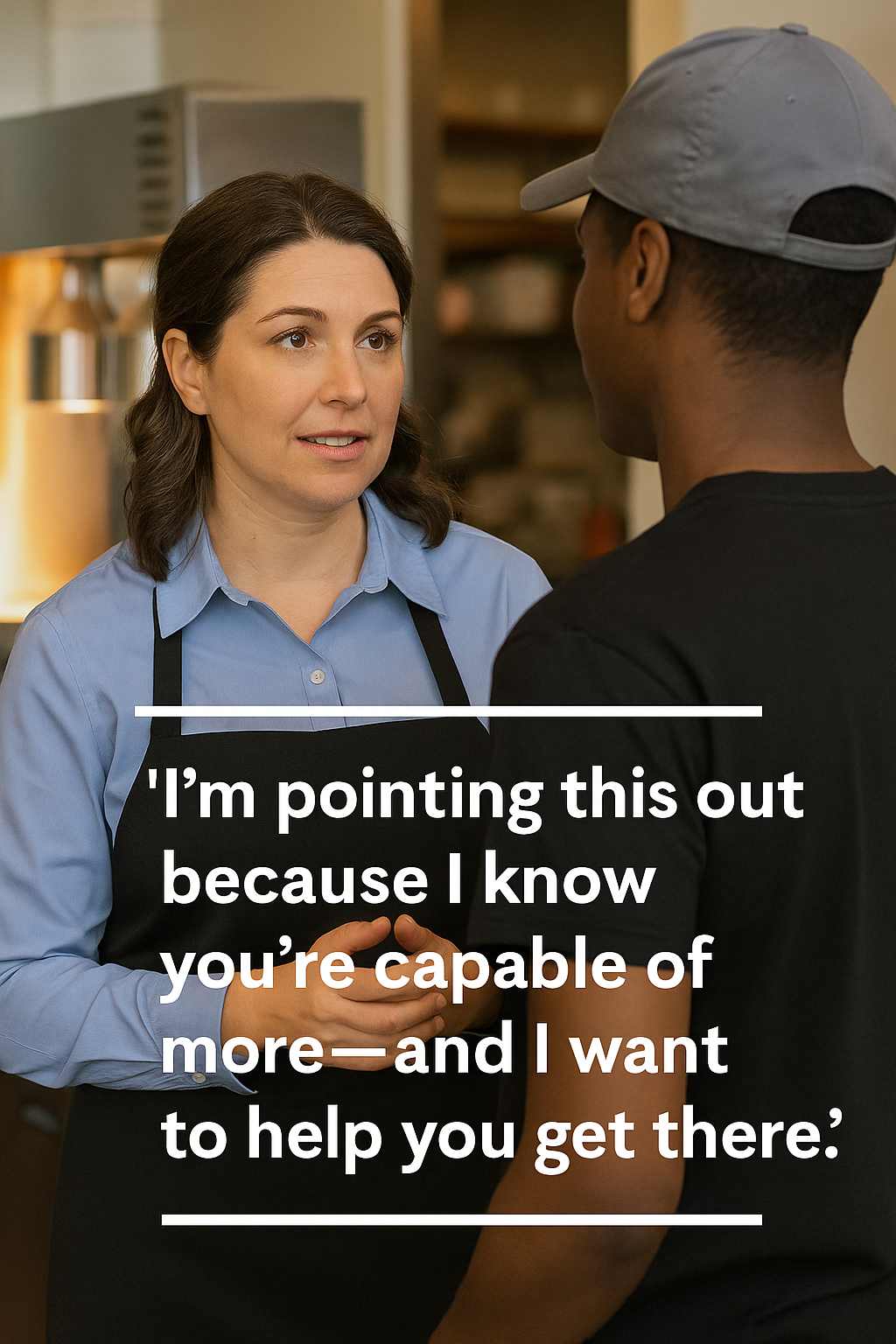
Script for tough love: “I care about you and your growth. I am also responsible for food safety and guest trust. Here is the gap I am seeing, here is what good looks like, and here is how I will help you get there. We will check progress Friday at 3:00.”
5) Handling Common Scenarios
- Chronic lateness. Clarify the standard, ask for root cause, set a plan (buffer alarm, ride share, swap request rules). Document the agreement. Next miss equals a formal step.
- Performance slump after promotion. Normalize the dip, narrow focus to two KPIs, pair with a coach for two peak shifts, follow up in seven days.
- Interpersonal friction. Meet 1:1 with each person, mirror their words, restate the shared goal, set a joint rule of engagement, monitor in the next overlap shift.
- Confidence gap in new hires. Assign a buddy, give one job they can win today, celebrate the win publicly.
6) Tools & Phrases You Can Use
- SBI (Situation–Behavior–Impact) for clarity.
- Feedforward: “Next time, try…” (future-focused).
- Cue-card coaching by the POS: Three lines only (script, add-on, allergy check).
- Two-by-two check: After each rush, decide what to keep and what to change.
Positive call-outs:
- “I noticed you restocked before we asked—that kept the line moving.”
- “Your greeting hit the script perfectly; the guest smiled and leaned in.”
Course-correctors:
- “Let’s reset together. Show me your next order from confirm to handoff.”
- “Pause. Which step of the melt are we on? Great, finish it and tell me the temp you’re targeting.”
7) What to Measure (So Coaching Isn’t Vibes)
- Customer Satisfaction / reviews: Look for named shout-outs and “friendly/helpful” trends.
- Customer Comments / throughput: Time saved when scripts and roles are crisp.
- Rework / complaints: Track first-contact recovery rate.
- Training completion: Monitor micro-clinic attendance and skill checkoffs.
- Retention & promotions: Watch tenure curves and internal step-ups.
- Safety & quality audits: Fewer criticals after targeted coaching.
8) A 14-Day Rollout Plan
- Days 1–2: Set the standard. Publish five non-negotiables and five coachables. Post them where the work happens.
- Days 3–5: Train leaders on the loop. Role-play the 5-minute coaching loop and tough-love script. Leaders coach each other.
- Days 6–7: Launch micro-clinics. Run three short clinics tied to the biggest misses. Track before/after.
- Days 8–10: Recognition blitz. Minimum three named shout-outs per shift. Pin wins to specific standards.
- Days 11–12: 1:1s with purpose. Run 15-minute check-ins and capture one skill goal per person.
- Days 13–14: Review & adjust. Read the dashboards and comments. Keep what is working, tweak what is not, and announce one promotion or development opportunity.
Conclusion
Compassionate coaching is not soft leadership—it is smart leadership. It treats people like people and keeps the bar high. When you lead with empathy and hold clear standards, you create a culture where team members grow, guests feel the difference, and results compound.
Strong people. Strong culture. Lasting impact.